Wednesday, March 15, 2023

a knife time to be alive

    In this unit of light, sound, and time, we focused on time, how it's measured, and what we can use it for. one example is finding the longitude or latitude at sea using GMT or the sun's position at noon. We covered sundials, arc calculations, and the famous equation E=mc^2. We also looked into space and talked about general relativity, time dilation, and the twin paradox, and we had Taylor Hoyt talk to us about what he does with astronomy and cosmic studies. We also looked at pendulums, and how helpful they are.


    My knife sharpener will essentially take the aspect of knife upkeep into play, and measure the time in-between sharpening, which will determine the date. The only times you'd need to sharpen are when the blade is dull, but for accuracy measure the blade sharpness before sharpening. The increments used will be anywhere from days to years. The display on the sharpener will say how much time has passed since sharpening. If the knife is used consistently the sharpening will be accurate enough to tell how much time has passed since sharpening. The user doesn’t have to constantly check and can carry the knife around, and use it for all its knife uses. Watches or phones are very expensive, but the knife made will be cost-effective and have the benefit of a tool and use in life. Using the arc angle equation, Arc Length / (2 πr), we can find how precise a cut was made. With the angle of the paper split being taken, it will accordingly calculate the time since the last sharpening. 


    A 6-inch blade length, using 420 hc steel, lasts six weeks. Approximately 58 Rockwell hardness. Damascus has about a 62 on Rockwell hardness, lasting significantly longer than 420 hc steel. I have both kinds of blades, and testing, if this theory is true, was simple, and worked. The Damascus blade lasted longer than the 420 hc and kept the edge longer. Even a 440-c blade can last a few weeks in-between sharpening. I’d use a caliper device that sits the blade edge on a piece of paper, and when cut, is measured in microns to show how precise the cut is, which varies depending on knife sharpness. The number correlates to how many days or weeks it has been due to how fine of a cut it is. The volume of the knife I tested (using the volume equation height x depth x width) was 0.2114 cubic inches.   

NO, sharpener example with a caliper, 2023


    In the image above, I used a caliper to replace the measuring device in my sharpener, but it's a similar idea.


                                                        NO, blade depth meter, 2023

                                                
                                                    NO, anatomy of device, 2023


    Overall, this project was fun and I got to think a lot about what I was making, and how I decided to innovate a new way to tell time. One thing I struggled with (and struggle with consistently) is formatting my post to make sense, but I'll keep working on that. One thing I did well was coming up with an idea and putting it on paper.


Thursday, March 9, 2023

can creativity be manufactured?

These are some of the projects I've done in my course, "manufacturing" where we look at different processes of creating products, and use them to make things for ourselves. iron-on vinyl, cardstock cut with a CNC, and laser etching my face into a tortilla. I've also used the laser to cut out a label for my tortilla launcher. 

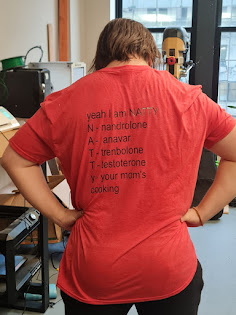
this was my friends idea, a heat transfer vinyl with natty spelled out in steroids. i used the silluette cutter to cut the words out, transfer paper to place it onto the shirt, then ironed on the vinyl. over all this project turned out great and I still wear the shirt regularly.
in this project, I used laser gerbl to transpose an image of my face onto a tortilla. the tortilla was kind of small, so I had to adjust the size of the image and set the fill as cross fill so It wouldn't take forever. this project was really cool and the tortilla tasted pretty normal. 

this was one of my earlier projects i did, i used cardstock to cut out a image for a bookmark. this had two parts to it, the initial image, then the background. this was one of the easier projects but still fun to do.


Thursday, February 23, 2023

good vibrations


This class is about how light, sound, and time have so many different properties, and what kind of daily applications there are. This unit is about sound, and the other properties it has. One example is the guitar. An acoustic guitar demonstrates reverberation, wavelength, frequency, and all while sounding good. We went to a violin maker to ask about acoustics and waves. One thing I'm really proud of is my physical project, which is an electric diddley bow. I struggled with written notes for the most part, but that's getting better. 
                                                        NO, diddley bow, 2023
This specific project is about creating an instrument that demonstrates all the concepts of sound we have gone over. So, we made a one-stringed instrument that shows each of the concepts we have learned. Here is an image of mine. My diddley bow creates sound by a wound string vibrating in front of a piece of metal called the pickup, which then takes those waves and sends them into an output, and carries a signal to an amplifier.

Basically, the diddley bow's string vibrates, which produces sound waves and causes differences in pressure waves. The magnets in a pickup catch the vibrations of the string, causing a disturbance and creating fluctuation, which is channeled into output through tone and volume knobs, which of course just toggle some aspects of the signal.


NO, diagram of the diddley bow, 2023


                                                NO, playing diddley bow with fretboard, 2023

math stuff

My string is a .70-gauge bass string.


String height- 1.6 in at nut 1.4 at the bridge.

harmonic marks are at:/
9.5 in, 13 in, 19 in, 25.8 in, 29 in.


My scale length is 38 in.


The loudest my diddley bow was acoustically reached about 70DB. About 10,000,000 times louder than the threshold of hearing. i wish i could see how loud it'd go through my amp, but I don't feel like that would be a good thing to do in a classroom. 


It is tuned to about d1, or about 37hz

The area of my trapezoid is 57in^2


The open note frequency of my string is 37hz.

2nd harmonic 74hz = 4.635135m

3rd harmonic 111hz= 3.09009m

4th harmonic148hz = 2.317568m

The trapezoid my bow makes has an area of 51^2in and the only two angles that have changed are 92 degrees to 88 degrees. The other two angles are 90 degrees.


conclusion


If I were to do this again, I'd make a more extended scale and more eye-pleasing diddley bow. mine looks pretty bad but it works and makes a sound. I was originally inspired to do this due to videos online and how cool they were, doing covers of Meshuggah on shovel guitars, using piano strings on pieces of wood, everything you could imagine. I love what I came up with and I'll probably use it for fun in the future.


Friday, February 3, 2023

music to my ear


In this unit of argument, we have dissected the anatomy of an argument and summoned our nation's founding documents as a reference to truly understand what this looks like. We have discovered unalienable rights, premises, and conclusions, and met with a Montessori school to understand the reason behind learning the way they do. 

Monday, January 30, 2023

a bright experience

 This course is about the study of light sound and time. Those are all very broad topics, with lots and lots encased within.  This unit is focused on the behaviors of light. So far, we have learned about light waves, frequency, sine, cosine, and tangent.


This action project focuses on the way light can be captured. To do this, we are making pinhole cameras. First, I took a shoebox and painted the inside black. Then, I searched for any light getting in and blocked it with tape. For the pinhole, I took a piece of a can and poked a hole into it about the size of a sewing needle. The pinhole camera works by stretching and expanding light through a hole the size of a pin. My camera demonstrates the concept of light absorption. As the light is going through a small hole, and transposing onto a piece of paper. However, there isn't any kind of image being reflected from the hole. The inside is black to ensure all light is only reflecting off of the white page inside. The inside is black to attempt to eliminate all light other than the pinhole from entering. This will cause distortion in the transposition. This demonstrates how light travels in straight lines. This is why the camera's picture is flipped. 


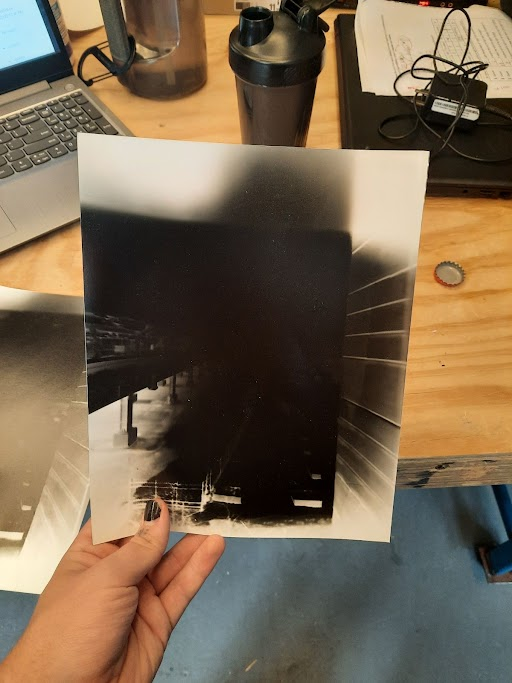
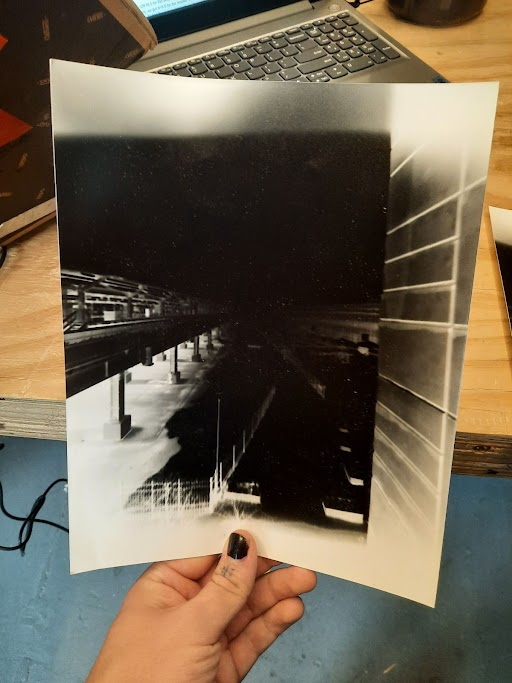
The two images below I took with my camera. I set a piece of photo paper on the side opposite of my lens. i then kept my shutter closed until I was ready to expose the paper. Then, I opened it and waited around five minutes, trying not to move. After the time was up, I closed the shutter until I was back in the darkroom for development. I dipped it in a series of developing chemicals and saw my image appear.

                                                       NO, 1/30/2022, Pinhole Camera Image

                                                       NO, 1/30/2022, Pinhole Camera Image
                                                            
NO, 1/30/2022, Pinhole Camera

NO, 1/30/2022, Diagram of Image Flip Through Lens


Math stuff


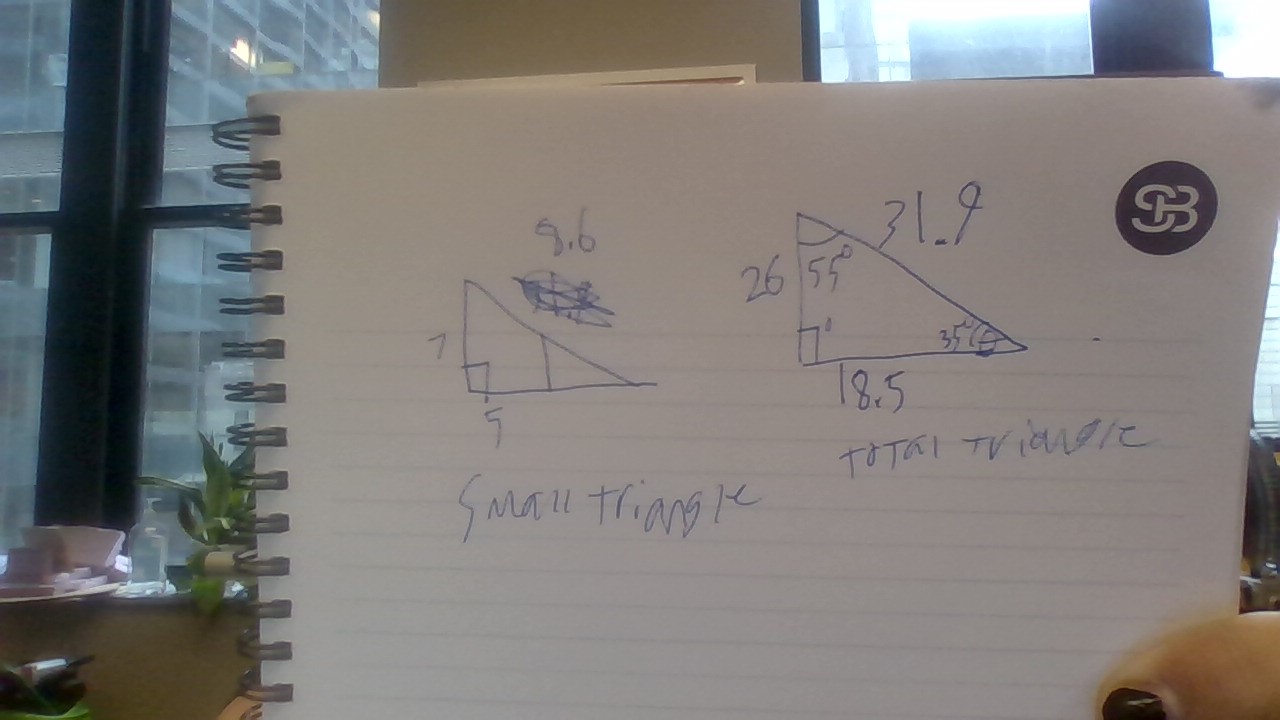
The overall calculation is 7/5=26/18.5 for the distance away from the object I would've photographed. Using the Pythagorean theorem, we get h=8.6 for the smaller triangle. For the large triangle, we get h=31.9 using the same process. To find the inverse tangent, we do op/adj and get 55 degrees. The last angle equals 35 degrees.


NO, 1/30/2022, Calculations


Overall, this was a great lesson and I had a lot of fun at Truman college. I had fun learning about all these concepts, and getting the opportunity to try out something new.


Thursday, November 10, 2022

there's a rhythm to rhetoric


In Art of Rhetoric, we have discussed rhetorart. We visited ONE northside, an organization fighting for the development of housing on the north side of Chicago. Our visit brought the use of rhetoric and the use of unity up, both of which are progressive and helpful in later life. Rhetorart is the usage of rhetorical devices through art forms. For my art form, I have chosen music, as I have a solid connection to music and wish more people could express themselves through it. In addition to the universality of my composition, I've chosen repetition and figures to drive my thesis and boost the amount of emphasis on why people have to know music is there to be enjoyed. This is just one of the barriers people face, however rhetoric can help break some of those down.


As a musician, I've associated with other musicians to better understand how music affects people similar to me around the world. Often people resort to social media to express themselves, however, there are some areas in the world where this is not allowed. Either social constructs, governmental cyber law, or platforms limit people's freedom of expression. However, music has stayed with humans as long as music has been around, and just about anyone can create harmony in one form or another. Most of the time, it is not just creating, but also listening and feeling other's music and expressing themselves that way. Not every person likes music, but everyone should care about this issue-young and old, rich and poor. Even if the person impacted doesn't originally like music, they know at least one person who does.


Music affects all people and not having freedom of expression can filter into all walks of life including music. Not everyone listens to music but usually, someone can identify with some kind of music. Any genre, any artist, and any time period. I have made a small composition just to give an example. Even though I have a lot of music knowledge, I have little experience with composing and creating full compositions. So, I decided to limit myself, by only using 10 minutes and limited resources, my guitar, some simple recording software, and that's all. I didn't need much else, as I had an idea almost immediately. I also attempted to make the composition appealing to multiple genres. It's calm, but sparkly, and driven. this music is not for those who know what I made or how I made it or what chords were used. This music is for those whose minds are unadapted to mixing the senses to experience and embody a moment fully. Back to rhetoric, one important part of my composition is the use of repetition. There are about 17 seconds of looped music that can be put in a loop forever. Each repetition is a restatement of something that was, and your creative mind is imagining something that currently, is.


Even if the listener doesn't know much about music, they can still listen to music and enjoy themselves. People naturally gravitate towards rhythm and consistent sound as it is hardwired in our brains. This affects the genres and songs we listen to and other decisions in day-to-day life. That being said, I want this audio to target younger audiences who haven't discovered the extent of music genres. This appeals to the untrained ear, the indecisive listener. The nuanced ear has only heard one genre in their household or community. I discovered mixed-genre music when I was young, and it shaped my relationship with music heavily. I hope that someone who might not exactly see music as their thing can experience the feeling of hearing something that speaks to them. In the end, a person who is yet unable to feel the music as an emotion might as well not listen at all. Music is for the open-minded, and not those who close their minds to the idea, or temptation of a melody merely being a platform for something impossible to comprehend, both out of curiosity and excitement. however, you must believe that theory is true in order to move to create.


works cited

Matacic, Catherine. (2016). Rhythm might be hardwired in humans | science | AAAS. science.org. Retrieved November 10, 2022, from https://www.science.org/content/article/rhythm-might-be-hardwired-humans 

.org, Soundcloud. (2007). Stream and listen to music online for free with SoundCloud. SoundCloud. Retrieved November

Tuesday, November 8, 2022

where par isnt up to par


Par For The Course is a class incorporating math principles into golf. We went to the Chicago Athletic Association, to see what golf is like. We also have made our own putting courses and saw first hand what works and what doesn't.  This AP  for Par For The Course is about a Sustainable Development Goal (Here is a link to the SDG’s website for reference) we think is important through the form of a golf course. Mine is the SDG 11 issue of housing in overpopulated countries or cities. My course is a model of a crowded environment. It's a hallway kind of straight line with no easy way to hit the ball. It symbolizes the crowded environment people have to deal with. There is also an organization called Cities Alliance, they are working to help with relief in parts of the world that are dealing with these issues. Some things that can be done to help are donating to organizations like Cities Alliance and reaching out to them. 


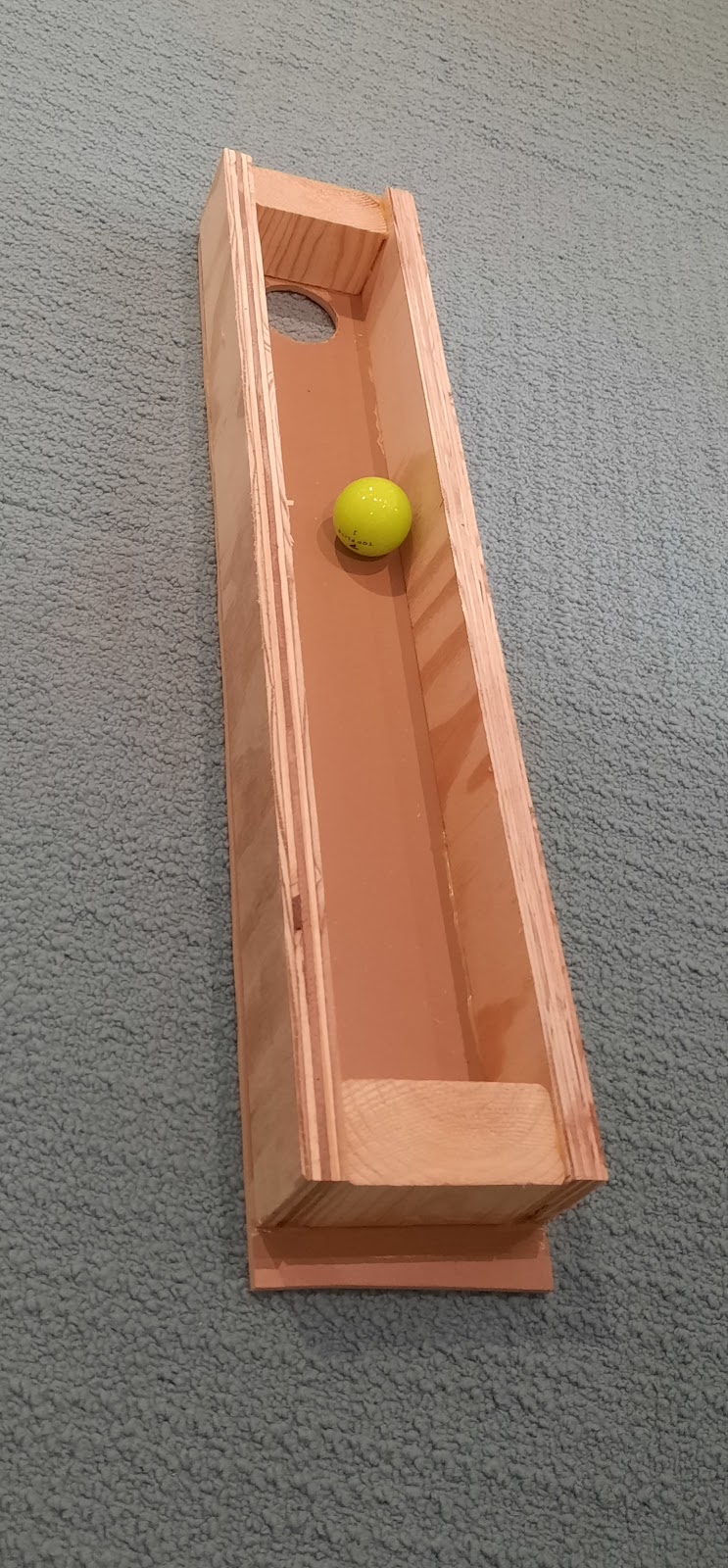
Onto my project, which is a hole I designed with the issue I’ve addressed above in mind. What I've done for my course is cut two pieces of wood to be walls like a long hallway, and two pieces of 2x4 are the stoppers. I'll then cut a hole at the end for a ball to fall through.


scale image, 2022, no


This is the scale drawing I made, each cube is an inch, and this is a 1:4 scale.

I have also started the gluing process. It was just 5 sides of a rectangle glued together with wood glue. 

,

Here is the final project. 


my last ap of junior year.

 The end of the year has arrived and so has the course Policy. We've spent the class learning about government and the three branches th...