Wednesday, December 15, 2021

Look out for the future!

So far in this term's course, Biomimicry, we have traveled all over the city to look at real-world examples of biomimicry. Biomimicry is when humans take processes or traits of organisms or ecosystems that have adapted to their environment and use those characteristics to invent sustainable ways to better humanity. We have gone to Lincoln Park Zoo and Conservatory, as well as Plant Chicago, and we met with a representative from a company called Interface, which took inspiration from a forest environment, to create a more sustainable carpet design. In my ap, I am using the process of biomimicry to create an invention to further our way to a more sustainable future. I chose to look at birds, their unique traits and feats, and then I got to work brainstorming ideas. I looked at a Red-Tailed Hawk’s eye (Buteo jamaicensis), and came up with modeling a contact lens utilizing its unique properties. Anyone can use the contacts, there aren't any specific targets for this product.


The Red-Tailed Hawk mostly inhabits Woodland places with tall trees. They have crazy good eyesight, sharp talons, and muscular legs. Their eyes are fixed so they can see the ground while flying high, strong legs to pick up small mammals like squirrels, and sharp talons to rip and tear. (Doom reference)


Below is a diagram of the contact and its approximate size.


Eye Drawing, (2021), NO

The contact design will be a three-layer contact, that covers a majority of your exposed eye. 
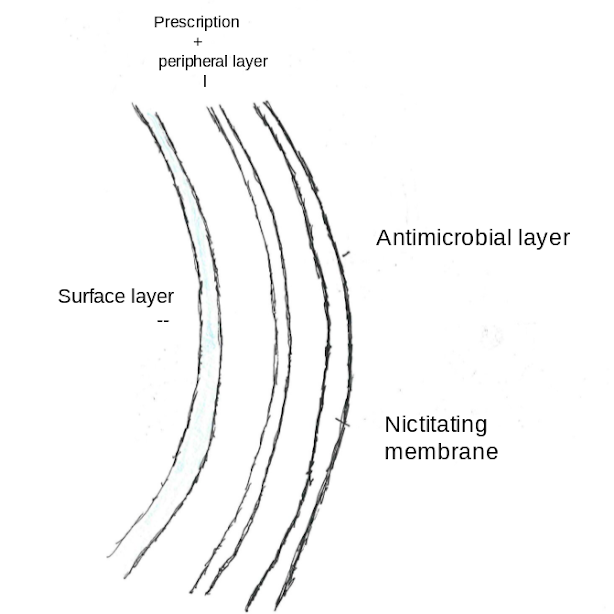
Layer#1, will be fitted to contour the eye, prior appointments with care providers may be necessary. This layer will be fitted to each individual eye.

Layer#2, will have modified wide-angle lenses plus prescription if necessary since near and far-sighted people have differently shaped eyes. 

Layer#3, will be a nictitating membrane that absorbs liquid from the eye, which allows you to not need to blink. This feature may cause tearing up, which will be normal. 

Although you can if needed, blink, it may be noticeable for the first few days. But the contact covers a majority of your exposed eye, so it will become natural over time. Below is a drawing of each individual layer. This design is also using a surface similar to sharks skin, which has an antimicrobial structure to it, so no bacteria or other micro organisms get into the eye.


Contact Layer Diagram, (2021), NO


We also looked at life's 6 principles. I think my invention aligns with the following two: evolve to survive, and conservation of resources. We will be enhancing human traits for better survival and better abilities. Also, my design will be lessening the waste of resources as is common with monthly contacts.


SDG's, or Sustainable Development Goals, are certain objectives set by the UN to break down the process of saving humanity one step at a time. There are 17 goals so far, and each one has sub-sections to it. My product fits under SDG #12 (responsible consumption and production). One of the milestones in SDG #12 is #12.5, which states "By 2030, substantially reduce waste generation through prevention, reduction, recycling, and reuse."


So how does my project incorporate sustainability? By using the resources we have, rather than introducing toxic inorganic materials into the environment. Instead of monthly waste of contacts, yearly replacement lenses will be applied and the old ones will be recycled and reused once repaired and sanitized. Less waste output=less toxic material introduction, as well as more resource development and utilizing closed-loop economies. The lenses can be reused if not badly damaged. Minor repairs can be made on them however large scars or breaks may result in the separation of the layers and recycling the materials to their base form. Also, they’re already more sustainable than regular contacts since they need to be replaced yearly. This will help both the consumer and producer.


Essentially, biomimicry will open doors for us, and we can learn from nature to solve some of humanity's challenges. This is a universally applicable concept, anyone anywhere in the world can use biomimicry to change the course of human evolution. We have to act now because climate change is putting us on a deadline. We need to make more closed-loop systems and get rid of non-reusable waste, but first, we need ideas. How can you help? Innovate. Solve. Act. Participate in the change we need.


source 1

insightvc. (2016, July 8). Human Vision VS Eagle Vision [web log]. Retrieved December 15, 2021, from https://www.insightvisioncenter.com/human-vision-vs-eagle-vision/.


source 2

Musgrave, C. S. A., & Fang, F. (2019, January 14). Contact lens materials: A materials science perspective. Materials (Basel, Switzerland). Retrieved December 15, 2021, from https://www.ncbi.nlm.nih.gov/pmc/articles/PMC6356913/#:~:text=Contact%20lens%20materials%20are%20typically,contact%20lens%20(CL)%20users.

source 3

Maizlish, A. (2018, December 24). Red-tailed hawk - the face of a Killer. Flickr. Retrieved December 15, 2021, from https://www.flickr.com/photos/amaizlish/45527679855


Wednesday, November 10, 2021

affected populations

in this ap, we looked at how a certain population was affected over a certain time period. i chose box turtles. below i have a video with two graphs, one of the human population and one of the box turtle population over the same time period (1995-2015)

fictional and non fictional heros.


Hello. Welcome back to my blog. In this ap, for stories, we are looking at the hero’s journey.

We went over the hero's journey steps, and questions to ask during the interview. Joseph Campbell was a man who made the hero's journey. He went through and created a whole process that heroes go through in their lifetime. These steps include the ordinary word, call to adventure, Refusal of the Call, Meeting the Mentor, Crossing the Threshold, Tests, Allies, Enemies, the abyss, The Ordeal, the return, resurrection, and resolution. We went to an art gallery to see an artist's work and ask questions about his work, and we will be making a mural with his help.


For this AP, we had to compare two heroes in our lives. I chose my friend Ahzanna and Napoleon Dynamite. We had to tracetheir steps on the hero's journey, and this slide show is what I used to do so. I chose Napoleon Dynamite because he's relatable and isn't recognizable as a hero, however, he fits the steps in a hero's journey. He's interesting, and he had interesting character development and goes against the typical story norms. I chose Ahzanna for my real-life hero because they understand what a hard life is and how to go through the processes a hero would. They have inspired me a few times, and made it clear they can take on the same challenges a hero would. These two are relatable because they are relatable in similar ways, and fit the heros journey


Saturday, October 30, 2021

how much did you know about bears?


for this ap, We were told to pick a species, and investigate. Ask three questions (one being quantitative) and then we did research. We had specific assignments corresponding to certain parts of the ap. Ursus arctos (brown bear) will be the subject of my research.


Brown bears are found on all continents. They like forests, mountains, hills, rivers, and heavily vegetated areas. They have brown fur to reduce stress in open light, large paws and claws to open rotted logs where bugs can be found. Brown bears come from Eurasia about 5 million years ago. they were originally small creatures unlike their current selves.. about 15,000 years ago a larger species of bear, was built with long legs and had an overall lighter build, it came around about 1.9 million years ago. It was called the 
giant short-faced bear. link to image, deviantart (Daikaiju-fanboy), 2015

How much do brown bears weigh on average? About 793lbs. What makes them so aggressive? They are very defensive and territorial. Brown bears will defend themselves against any perceivable threats. where did they originate? They originated in Europe and Asia, around 5 million years ago. Since then, they have spread out around the world, populating almost every continent. For this ap, we were instructed to create a new habitat for the animal we chose. I'd imagine a well-populated forest, lots of large trees, and rock formations. Bears love these, as they often hold good places for dens, and also opportunities for hunting. Trees, for shelter, or to sharpen their claws on, and population for meals.


Population size: 11

Median: 775

Minimum: 400

Maximum: 1200

First quartile: 550

Third quartile: 1075

Variance = 7,451.1

standard deviation = 86


Mean: 752.5  median: 775 

x( data point)

(x - Mean)

( x - Mean)^2

400

-752.5

124,256.25

475

-752.5

77,006.25

550

-752.5

41,006.25

625

-752.5

20,081.25

700

-752.5

2,756.25

775

-752.5

506.25

850

-752.5

9,506.25

925

-752.5

29,765.25

1075

-752.5

104,006.25

1150

-752.5

150,006.25

1200

-752.5

200,256.25


sum of ( x - mean)^2

624,152.75

Variance: 62,415.28    Standard deviation: 249.83


Monday, October 18, 2021

critical race theory in schools


this ap in the war on x is about critical race theory, and how it's been taught in schools. 
script 

Why did schools ban crt? 

Crt, or critical race theory, is basically claiming that race is a social construct. This I disagree with. I can agree that some aspects of race are incorrect, however, I feel race wasn't made specifically for the oppression of others. Parents in orange country seem to agree, as they thought that they (the parents)  should be teaching their kids, not the schools, which I agree with. Somebody who disagrees with my opinion would probably say that we should correct our definition of what CRT is. However, I believe that crt shouldn't be taught through schools in the first place. I feel like it should be the parent’s job to introduce this concept to the child or student’s mind. An article on brookings.edu’s website states that crt is talking about how systemic racism is apparent in today’s society. This is a blog and is very opinionated, however, the fact that it came up as the first search result for “News on crt in schools” and the first point is about Fox News, is a bit alarming. From that note, I found a less opinionated source from the USA today, and funny enough, below that were two fox news articles, as were mentioned in my first source. The USA Today article states that crt was politicized, as though it wasn’t already. I feel as though most controversial statements in today’s society often come out as political, rather than just stating the ethics behind them. People always quote the past and don’t often look for the future of society. 

The school system is for learning the basic principles to set young people up for success. Although, a study was released that showed that black students wanted crt in their curriculum. That being said, schools should have optional courses for controversial topics, like crt. This way, those who show interest in that topic have the outlet to learn such topics, however, this will also give the other students the opportunity to choose to not indulge in controversy, giving further diversity to the curriculum. My third-grade year in school was mostly learning about black history, as our teacher chose to teach that rather than the schools provided curriculum. This showed me a lot at a young age, and I didn’t participate in class much because I didn’t really want to dive into something that seemed so tragic and mature. It almost scared me to see all of that at such a young age. However, I feel like this shaped me a bit at the same time. In the end, I don’t think it should be completely wiped from the school system, however, it’s not something to be taught messy. It has to be done right, or not at all. There should be a certification for teaching that topic, to be completely unbias. Opposing sides claim the younger children are taught crt, the better knowledge they will have on the topic. I don’t agree. I think it’s too young for kids to be learning the ways of politics, and should be taking more time to learn basic reading and writing skills, and math that is appropriate for their age. I feel like there is a point, they should be able to learn what they want. But I know for a fact learning false information at a young age can be catastrophic. Therefore the learning process should take place in high school, at the earliest.


Monday, October 11, 2021

The battle of the bridge.


In this story, we have the main character, me, a spider monkey, my guitar, and the bridge. Now, this is a little weird, but it has all the necessary aspects of a fable. A fable is a story conveying a moral with animals as the characters. Often times the animals show human characteristics. We had a professional storyteller come in and tell us about her experiences, plus some stories.


Full version:

Once upon a time, a teenage guitarist named NO went to a guitar center with his dad and about 75 dollars to spend on accessories for his brand new guitar. So, he bought a cable, a nice strap, some picks, and as they were checking out, he saw something on the shelf that made his heart drop. The infamous 8 gauge strings. They were so special because they had so much less resistance when playing, it made it much easier for him. He had 10 dollars left in his budget, so he ran over and picked them up. He was overjoyed at his find!


His father asked “What are you going to do with those?”

NO said, “I'll put them on my new guitar.”

NO’s father laughed, and said, “Good luck with that! It'll take you forever to do that!”

He didn’t have opposable thumbs, therefore it made this task even more difficult.

NO felt defeated, as he knew it'd be a struggle to change the strings on his guitar as a spider monkey, he did not have opposable thumbs. In addition, the guitar itself had a certain feature that made it particularly difficult to restring.


It had… A FLOATING BRIDGE!!


This means that the bridge is held in place by a set of springs inside the guitar, as well as the strings themselves. This meant NO had to balance them so the bridge was flush with the body, otherwise everything would be off. What made this even more difficult, was the fact that he had a lighter gauge string set, which meant less resistance on the bridge, so it was off put a bit. AND, he would also have to tune it after calibrating the bridge, which would offset it further. It's a tedious process and one not for the faint of heart.


But NO put this task off. Finally, at 2am one night he decided he had enough. He was going to do it. This villainous bridge was no match for his awesomeness. He cut the first string off, unlocked the tuning peg, and unwound the string. He then loosened the nut on the bridge and replaced the string with the new one. NO then tightened the locking nut and proceeded to do the rest of the strings. This took thirty minutes on its own. Afterward, he looked at the bridge.

Wholly cow! It was way up in the air!

He then tightened the springs on the inside of the guitar. Now, it was flush. “Perfect!” NO said.


He then strummed the guitar once. Oh. he forgot. It was insanely out of tune now. This hurt his pride a little, his confidence in succeeding now damaged. He wasn't giving up though. He unlocked the tuners, and tuned it, loosened, tightened, took springs, added springs, adjusted, locked, unlocked, and finally, he had done it. It was not only perfectly in tune, but also perfectly balanced. NO was nearly shaking with his triumph over the bridge. He knew he would have to tune it in the morning as the new strings would stretch out a little, but that was no biggie. He showed everyone, and of course, nobody really cared, but he was happy. He had defeated the bridge and now played his newly string guitar happily. The end.


The moral: hard work never goes unrewarded.

my last ap of junior year.

 The end of the year has arrived and so has the course Policy. We've spent the class learning about government and the three branches th...